Visual math Labs for every classroom
Interactive tools where students change something and watch the math respond. Use them for whole-class demos on the projector, warm-ups, or stations on student devices.
Number sense & fluency 6 Labs
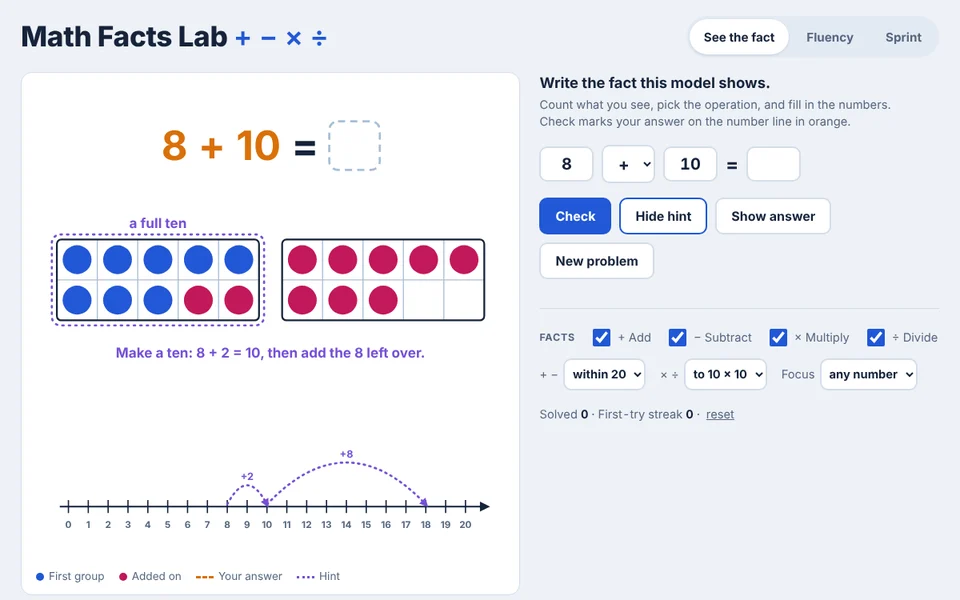
Math Facts Lab + − × ÷
Write the fact a ten-frame or array shows, or drill facts in a 1-minute sprint. Hints show make-a-ten and break-apart strategies; feedback catches mistakes like adding instead of multiplying.
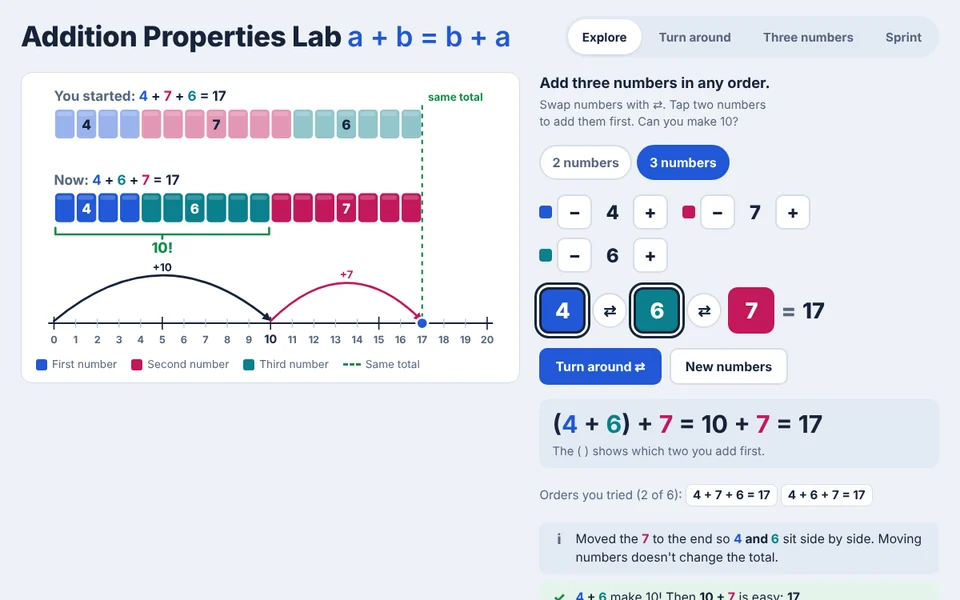
Addition Properties Lab a + b = b + a
Turn cube trains around and add three numbers in any order to see the total stay the same, and look for two numbers that make 10. Feedback catches mistakes like changing the total or forgetting the third number.
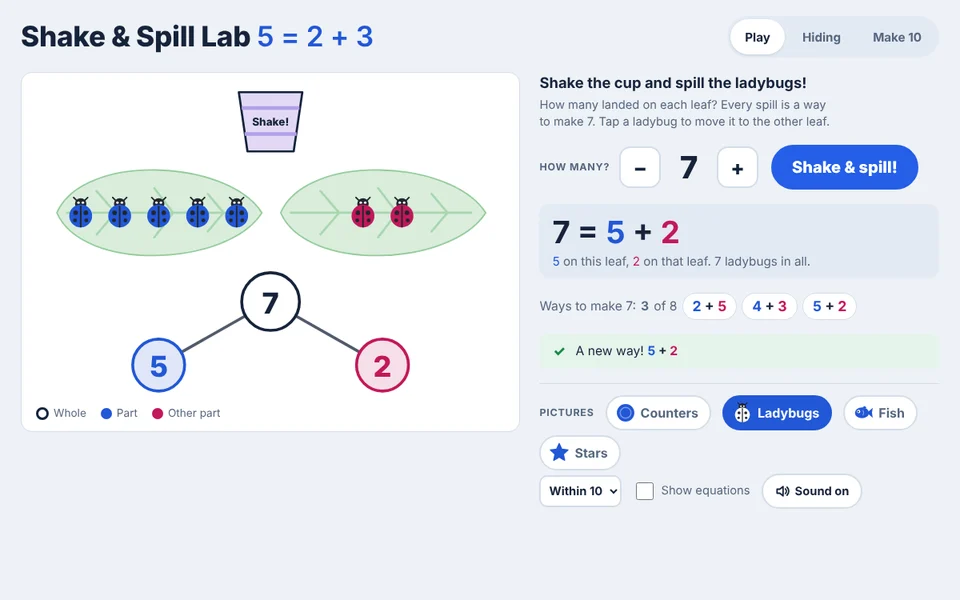
Shake & Spill Lab 5 = 2 + 3
Shake a cup and spill ladybugs, fish, stars, or counters to find every way to make a number, find how many are hiding, and fill a ten-frame to make 10. Hints count on with the kids, and right answers end in confetti.
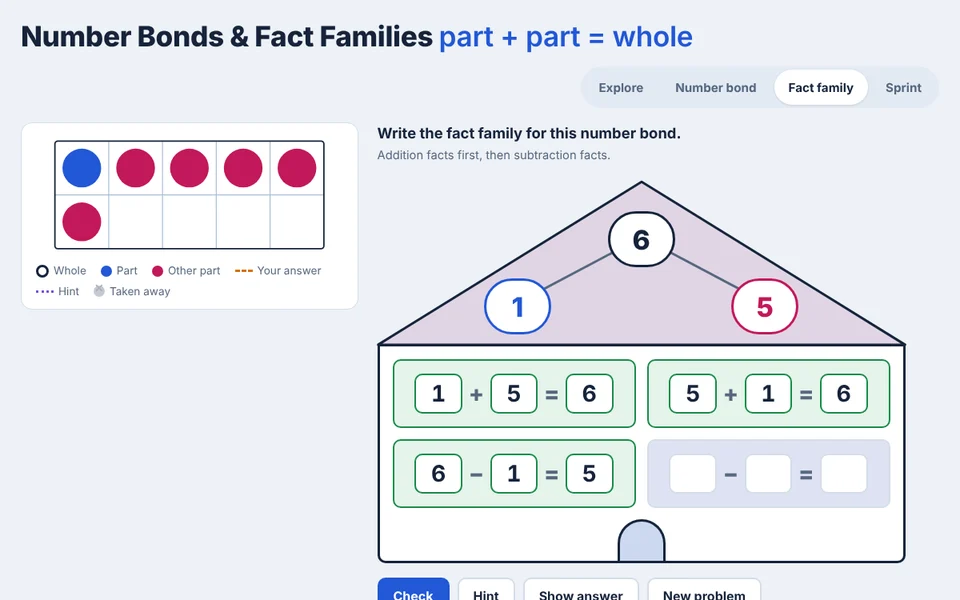
Number Bonds & Fact Families Lab part + part = whole
Split a whole into two parts with counters on a ten-frame and watch the fact family appear, then find missing parts and fill the fact family house, where each fact lights up a room. Feedback catches mistakes like putting the whole in the wrong place or writing the same fact twice.
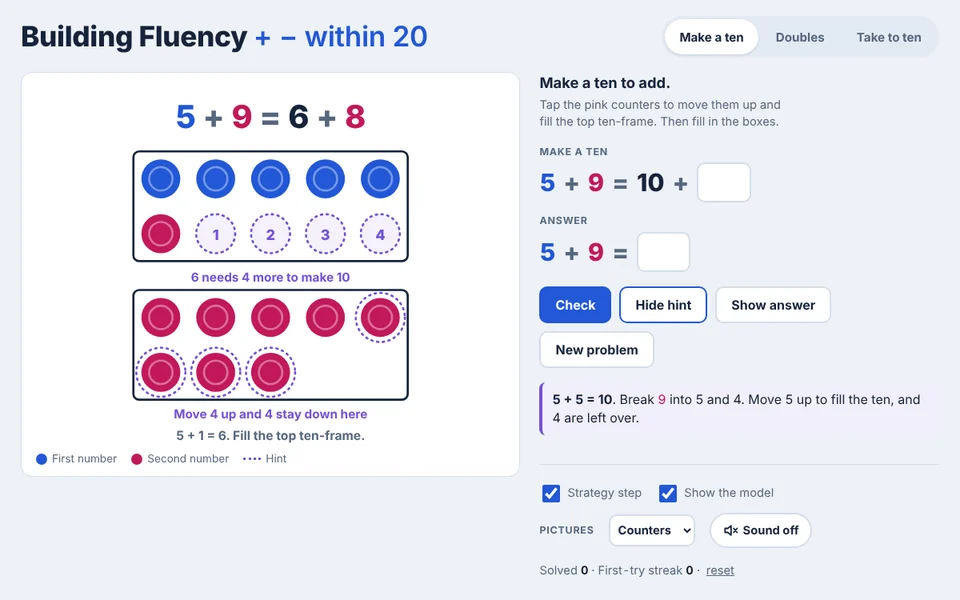
Building Fluency Lab 8 + 5 = 10 + 3
Add and subtract within 20 by making a ten, using doubles, and taking away to get to 10, with counters on ten-frames and cube trains. Feedback catches mistakes like forgetting the ten or doubling the wrong number.
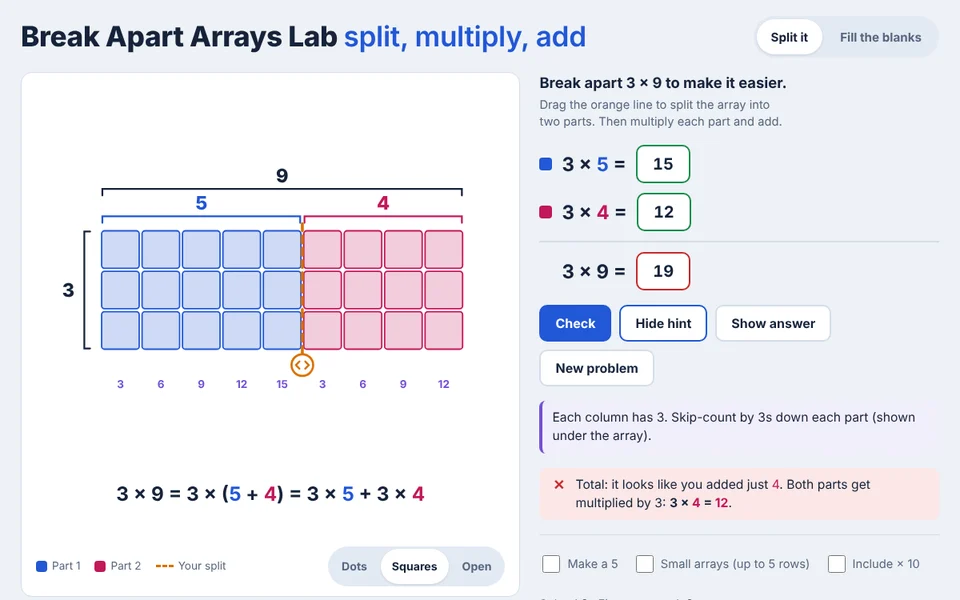
Break Apart Arrays Lab split, multiply, add
Drag a line to break an array into two easier facts, multiply each part, and add, with dots, squares, or an open area model. Feedback catches mistakes like adding instead of multiplying or multiplying only one part.
The number system 1 Lab
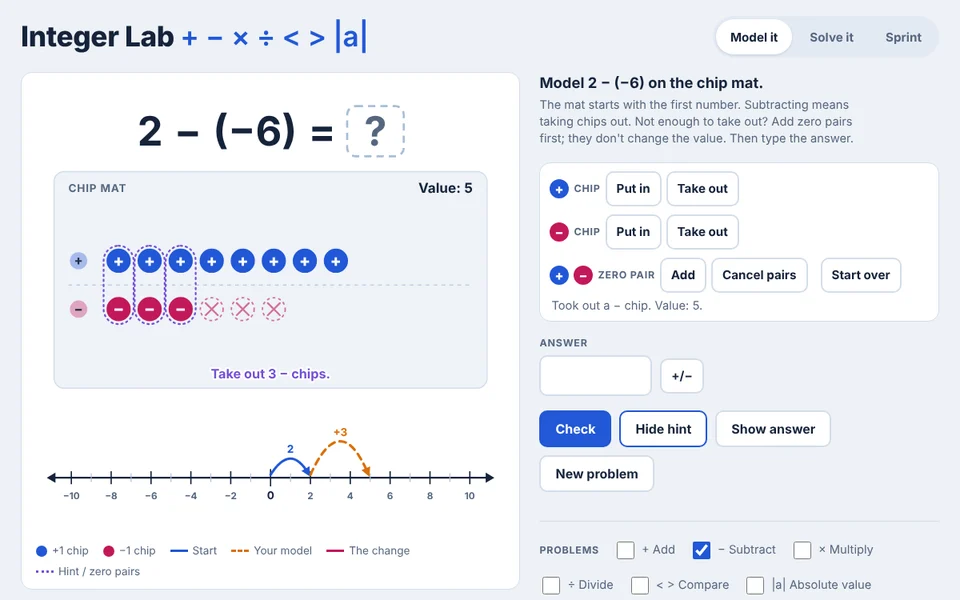
Expressions & equations 2 Labs
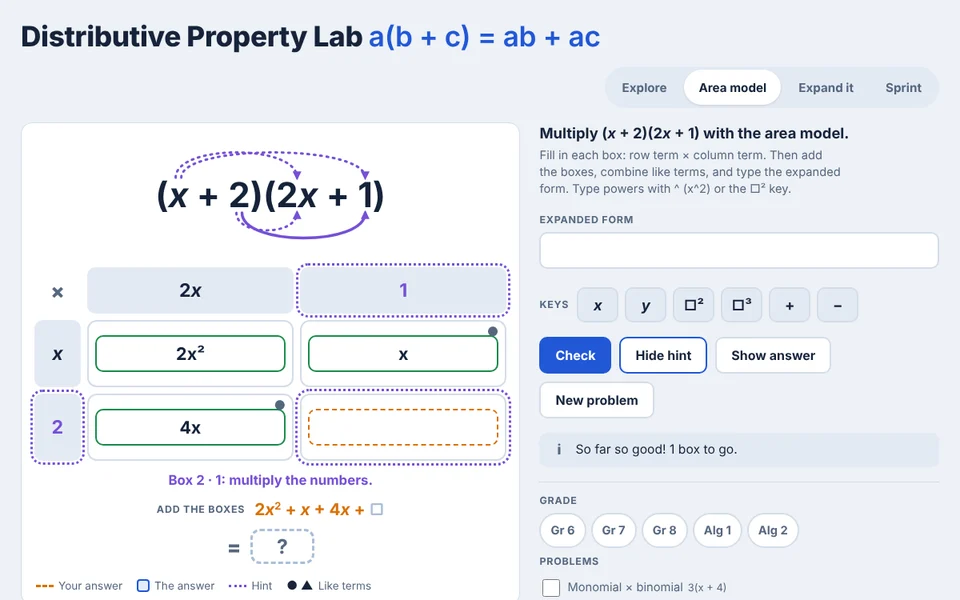
Distributive Property Lab a(b + c)
Multiply with an area model, from 3(x + 4) up to binomial × trinomial, then combine like terms and race a 1‑minute sprint. Feedback catches mistakes like distributing to only the first term or writing (x + 3)(x + 5) as x² + 15.
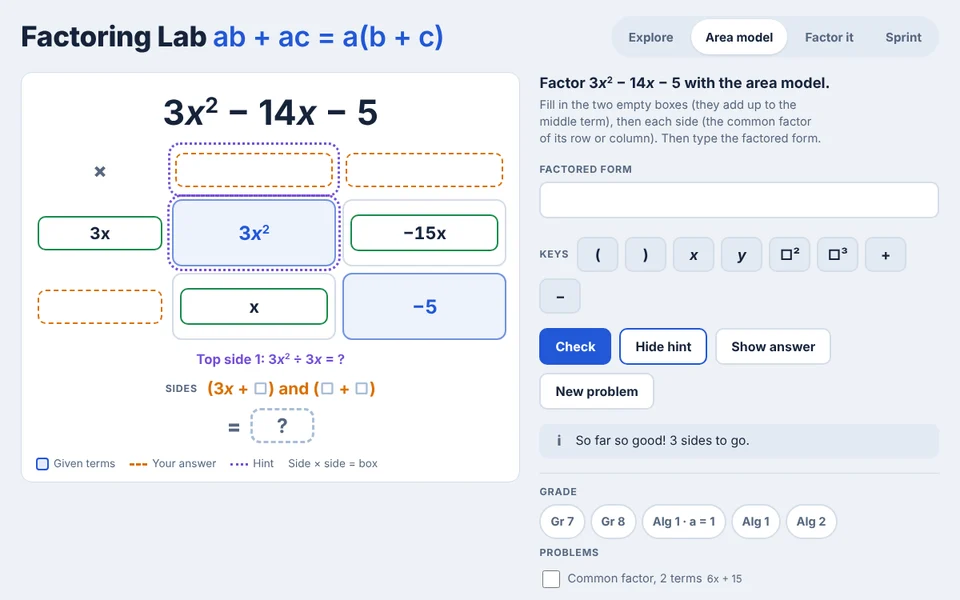
Factoring Lab ab + ac = a(b + c)
Factor with an area model, from 6x + 15 to trinomials, differences of squares, and perfect squares, including factoring completely (GCF first), up to x⁴ − 5x² + 6 and x²y² − 9. Feedback catches mistakes like a pair that multiplies right but adds wrong, or a common factor left behind.
Linear relationships 4 Labs
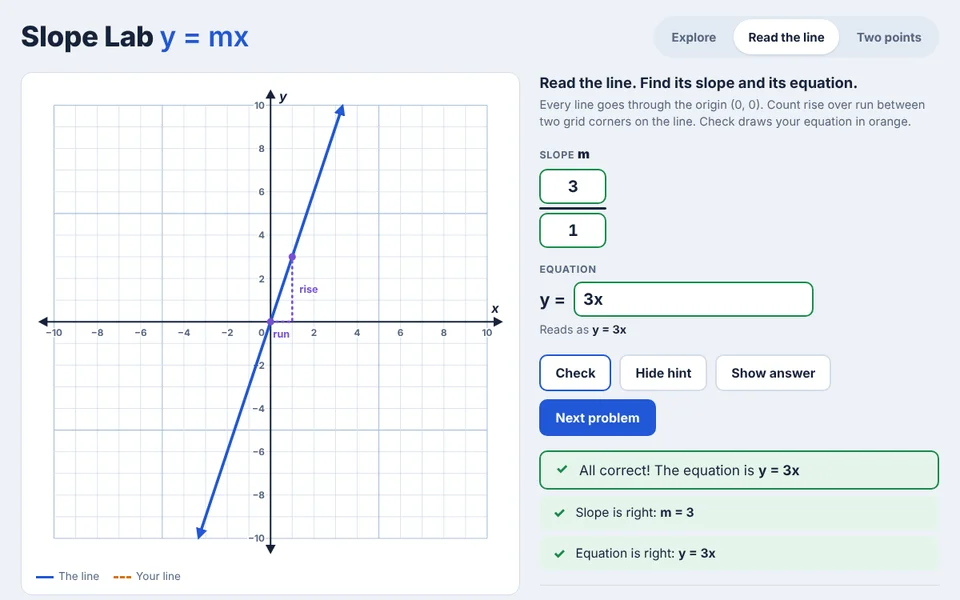
Slope Lab y = mx
Read a line's slope from a graph or from two points, then write its equation. Hints draw the rise and run, and Check draws the student's line in orange.
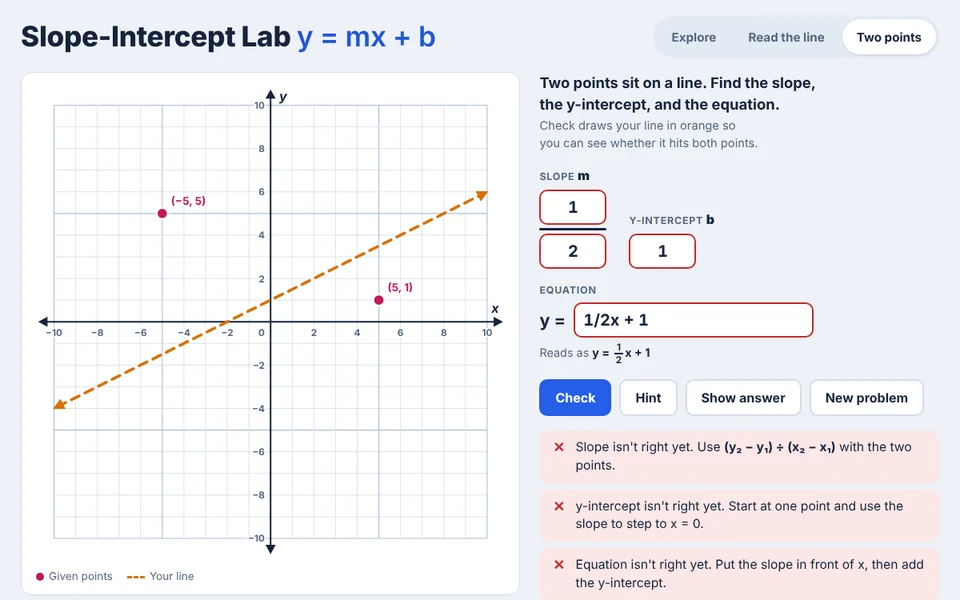
Slope-Intercept Lab y = mx + b
Find the slope, the y-intercept, and the equation y = mx + b. Feedback catches common mistakes like a flipped rise/run or a wrong sign.
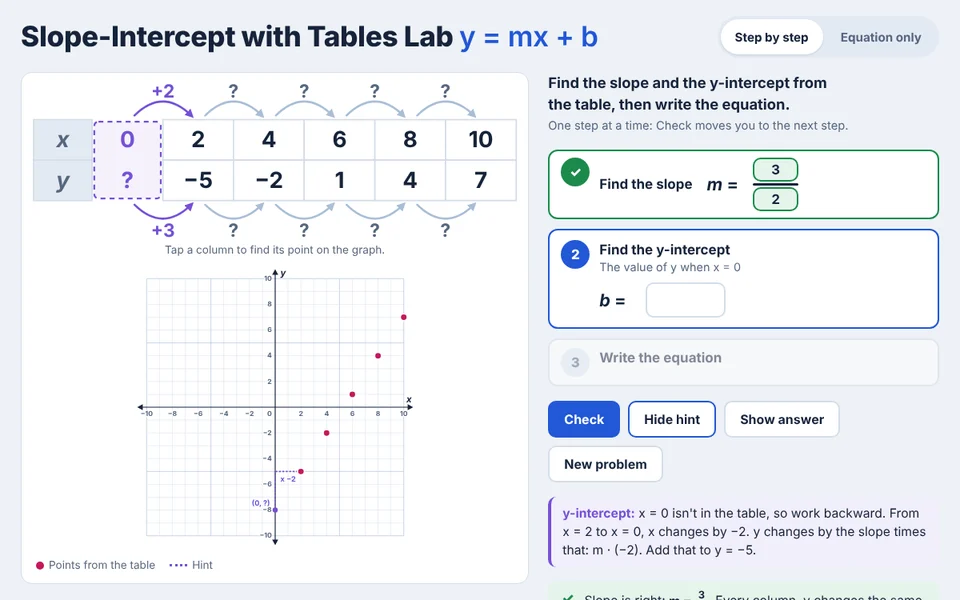
Slope-Intercept with Tables Lab y = mx + b
Find the slope and y-intercept from an x-y table, then write y = mx + b. Change arrows link the table to a graph, and feedback catches flipped changes and a missed x = 0.
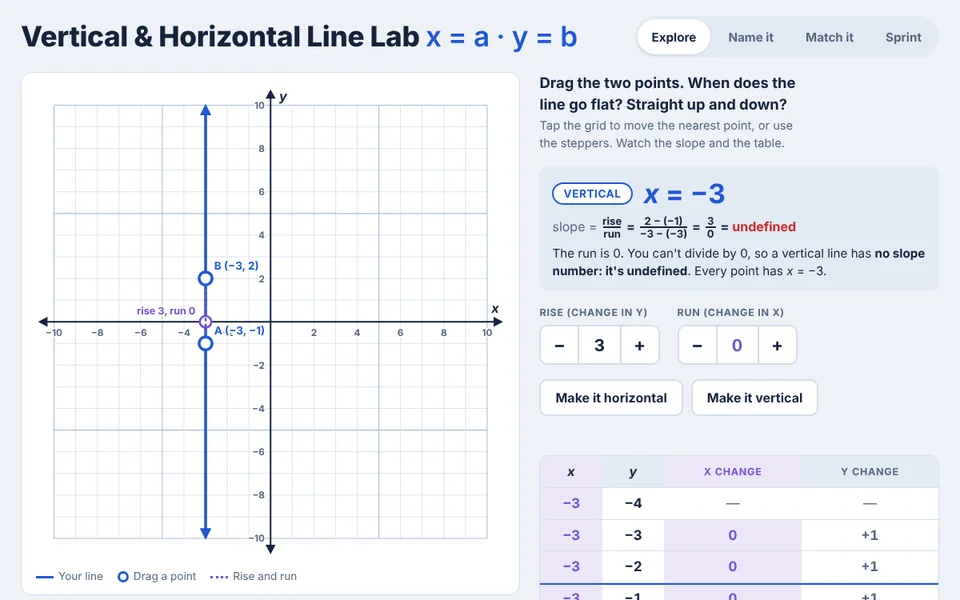
Vertical & Horizontal Line Lab x = a · y = b
Drag points until the line goes flat or straight up and down to see why the slope is 0 or undefined. Feedback catches x/y swaps and slope mix-ups.
Geometry & measurement 1 Lab
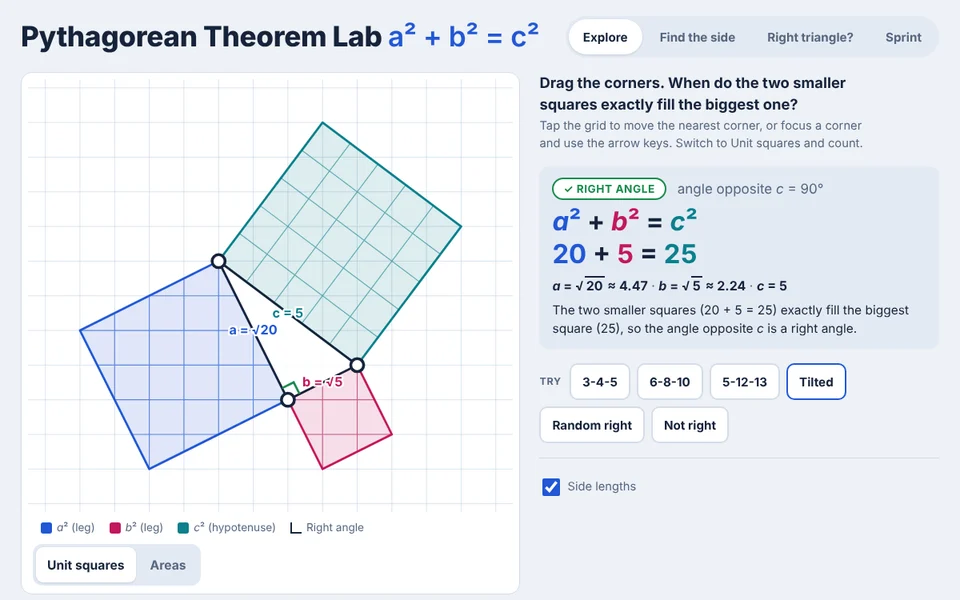
Pythagorean Theorem Lab a² + b² = c²
Drag a triangle and count the squares on its sides to see when a² + b² = c². Feedback catches adding instead of subtracting, a forgotten square root, and a + b = c.
More Labs on the way
- Elementary through high school
- Algebra, geometry, statistics, and calculus
- Same look, same tools, always free